

The first light of dawn painted Iceland’s southern tundra in soft blues and grays as I drove out of Reykjavík. My rental car’s heater hummed, fighting off the crisp September chill, and I gripped the wheel tighter as the road stretched ahead—flanked by moss-covered lava fields that looked like a fuzzy green carpet spread over black rock. I’d come for the Golden Circle, Iceland’s most iconic route, and by 8 a.m., I pulled into Þingvellir National Park, the first stop—and already, I felt like I’d stepped onto another planet.
Þingvellir isn’t just a park; it’s where the North American and Eurasian tectonic plates pull apart, a gap in the earth that’s slowly widening each year. I walked along a wooden path to the edge of the rift, where clear water filled the crack below, glinting like liquid glass. I knelt down and touched the rock—cold, rough, and ancient—and a park guide nearby said, “This is the only place on Earth where you can stand between two continents and see the split.” A family from Canada stood beside me, their kids leaning over the rail, eyes wide. “It feels like the earth is breathing,” the mom said. I nodded, watching a single seagull glide over the rift; in that moment, Iceland’s raw, geological power felt tangible.
Next, I drove 45 minutes to Gullfoss—“Golden Falls”—and the moment I opened the car door, I heard it: the roar of water, loud and relentless. I pulled on my windproof jacket (Iceland’s wind cuts like a knife, even in summer) and walked toward the viewpoint. There it was: the Hvítá River plunging 32 meters into a narrow canyon, its white foam catching the sunlight and turning gold—hence the name. I edged closer to the rail, and a fine mist sprayed my face, cool and refreshing. A local elder sat on a bench, feeding seagulls, and he pointed to a smaller path. “Go down there—you’ll feel the spray on your hands,” he said. I did, and as I stood at the lower viewpoint, the waterfall surrounded me: the sound, the mist, the way the water churned at the bottom like a wild, blue whirlpool. It wasn’t just a waterfall; it was a force of nature, unapologetic and magnificent.
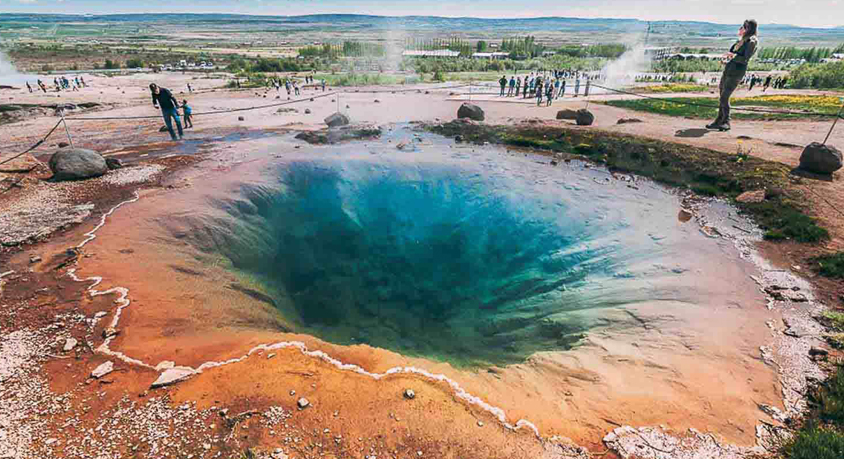
By noon, I was starving, so I stopped at a small café near Geysir (the third stop) and ordered a bowl of lamb soup—rich, hearty, with chunks of tender meat and root vegetables. The waitress laughed when I added extra bread. “You’ll need the energy for the geyser,” she said. She was right. When I reached Geysir, a crowd had gathered around Strokkur, the most active geyser (Geysir itself rarely erupts now). We waited, chatting—tourists from Brazil, Germany, and the U.S.—and every few minutes, Strokkur would bubble, sending a small spray of water into the air, making the kids giggle. Then, without warning, it happened: a column of water shot 20 meters into the sky, white and frothy, as the crowd cheered. I fumbled with my camera, but I didn’t care if the photo was perfect—I was too busy staring, mouth open, at the spectacle. Strokkur erupted every 10 minutes, like clockwork, and I stayed for three more bursts; each time, the crowd’s joy felt new, like we were all sharing a small, magical secret.
I’d saved the best for last: chasing the Northern Lights. I’d booked a night tour from Reykjavík, and at 9 p.m., we drove back toward the Golden Circle, away from city lights. We parked in a field near Þingvellir, and our guide handed out hot cocoa. “Be patient,” he said. “Auroras are shy.” We waited 45 minutes, stamping our feet to keep warm (my thick woolen socks were a lifesaver), and then someone yelled: “Look!” I looked up, and there it was—a faint green glow, stretching across the sky, like a silk ribbon waving in the wind. It brightened, then faded, then brightened again, swirling and dancing. The group fell silent, except for the click of cameras (my tripod held my phone steady, capturing the moment). A young couple held hands, and I felt a lump in my throat—this was why people come to Iceland: not just for the waterfalls or geysers, but for moments like this, when the sky puts on a show you’ll never forget.
Practical tips: Visit the Golden Circle in June-August for mild weather and 20 hours of daylight (great for hiking!), or September-March for Northern Lights and fewer crowds (but pack extra warm layers!). Rent a 4x4 if you’re driving—some rural roads are gravel and slippery. Bring a windproof waterproof jacket (invest in a good one—you’ll use it everywhere) and thick woolen socks. Book Northern Lights tours in advance, and choose a small group—you’ll get better views. And don’t skip the lamb soup or Icelandic hot dogs (topped with crispy onions and remoulade)—they’re simple, but delicious.
As I drove back to Reykjavík that night, the aurora still glowing faintly in the distance, I thought about the day: Þingvellir’s rift, Gullfoss’s roar, Strokkur’s eruption, and the green light in the sky. The Golden Circle isn’t just a route—it’s a crash course in Iceland’s soul: its fire, its water, its sky. I left with cold cheeks, a camera full of photos, and a heart full of wonder.

