

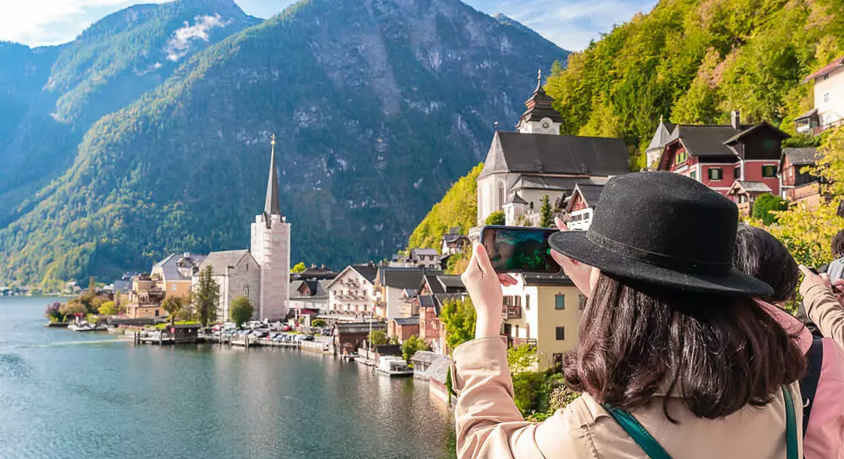
The train ride from Salzburg to Hallstatt felt like a slow reveal of magic. As we wound through the Austrian Alps, green valleys gave way to snow-dusted peaks, and then—suddenly—there it was: Hallstatt Lake, a sheet of turquoise that shifted to deep blue as the light changed, with the town’s red-roofed houses clinging to the hillside like scattered gemstones. I grabbed my waterproof camera (determined not to miss a shot) and hurried off the train, the air crisp with pine and the faint saltiness of the lake. By the time I reached the lakeshore, I was already smiling—this place didn’t just look like a postcard; it felt like stepping into a dream.
My first stop was a morning boat tour on Hallstatt Lake. The wooden boat glided silently over the water, its wake leaving silver ripples that shimmered in the sun. Our guide, a local named Lukas, pointed out hidden waterfalls that trickled down the mountainside and told stories of the lake’s history—how it had sustained the town for centuries, providing fish and a trade route. “Look closely,” he said, gesturing to the water. I leaned over the edge and gasped: the lake was so clear, I could see schools of fish darting between smooth stones 20 feet below. Halfway through the tour, we anchored near a small beach, and I dipped my hand in the water—cold, but invigorating, like a splash of Alpine freshness. A family from California sat nearby, their kids laughing as they skipped stones, and for a moment, the only sounds were the lapping of water and the distant call of a bird. It was quiet, perfect, the kind of peace that’s hard to find anywhere else.
After the boat tour, I headed to the Hallstatt Salt Mine—one of the oldest working salt mines in the world, with a history stretching back over 7,000 years. I pulled on my comfortable hiking shoes (a good call, since the path up the mountain was steep) and joined a small group at the mine’s entrance. We were given traditional miner uniforms—thick gray jackets and hats—and led into the mountain via a narrow train that rumbled through dark tunnels. Inside, the air cooled, and the walls glistened with salt crystals that looked like tiny diamonds in the dim light. Our guide explained how ancient miners had chipped salt from the rock using simple tools, and even let us touch a piece of raw salt—coarse, crunchy, and surprisingly heavy. The highlight? A wooden slide that miners once used to move between levels of the mine. I hesitated at first, but the guide laughed and said, “Go on—everyone does it!” I sat down, pushed off, and whooped as I zoomed down the slide, the wind in my hair. It felt like being a kid again, and I emerged at the bottom grinning from ear to ear.
By noon, I was starving, so I wandered into a small lakeside restaurant called Seelust. The owner, Frau Schmidt, recommended the lake trout—freshly caught that morning, pan-seared and served with buttered potatoes and a side of local spinach. I sat at a table with a view of the lake, and when the food arrived, I took a bite and sighed—it was tender, flavorful, and tasted like the mountains themselves. I washed it down with a glass of Austrian Grüner Veltliner, a crisp white wine that paired perfectly with the fish. Frau Schmidt stopped by my table later and said, “You picked a good day—tomorrow might rain.” I thanked her and pulled out my folding umbrella (a last-minute purchase that would soon come in handy) to check it was ready—better safe than sorry in the Alps.
My favorite moment of the day came in the late afternoon, when I walked up the hill to the Hallstatt Skywalk. From there, I had a 360-degree view of the town and lake: the red roofs, the turquoise water, the mountains stretching to the horizon. A couple from Boston was taking photos, and we chatted about how we’d both stumbled on Hallstatt by accident—they’d added it to their itinerary last minute, and I’d found it in a travel blog. “We should have planned more time here,” the woman said, and I agreed. There’s something about Hallstatt that makes you want to slow down, to sit on a bench and watch the lake for hours, to let the beauty sink in.
Practical tips for anyone planning a trip: Hallstatt is easiest to reach from Salzburg—take a 1.5-hour train to Bad Ischl, then a 45-minute bus to Hallstatt (buy a combined ticket to save money). Visit between May and September for mild weather and open boat tours; December is magical too, with the town decorated for Christmas and snow dusting the roofs. Wear layers—mornings by the lake are cool, but afternoons can be warm, and the salt mine is chilly year-round. Book the salt mine tour online in advance to skip lines, and bring a waterproof camera—you’ll want to capture every moment by the lake.
As I left Hallstatt that evening, the sun was setting over the mountains, painting the sky pink and orange. I looked back at the town, its lights starting to twinkle, and felt a pang of sadness—this was a place I didn’t want to leave. Hallstatt isn’t just a town; it’s a feeling—a reminder of how beautiful the world can be when nature and history come together. I left with a camera full of photos, a full stomach, and a heart full of memories. And I know one day, I’ll be back—maybe to see the Christmas market, maybe just to sit by the lake and eat that trout again. Either way, Hallstatt will be waiting.

