

After washing your hands, do you usually dry them with a hand dryer, use paper towels, or simply shake your hands and walk away?
There is a common belief that hand dryers in public restrooms are like bacterial incubators—that blowing your hands with them only makes them dirtier. This claim is not entirely correct, but it does hold some truth.
If you visit a dirty restroom that happens to have only an old-style warm-air hand dryer, it may indeed be “worse to use than not to use.”
There are two common types of hand dryers found in restrooms: warm-air hand dryers and jet-air hand dryers.
Warm-air hand dryers are the ones often seen in roadside restrooms that blow air downward. The airflow speed from warm-air dryers is usually not very fast (older models may blow at less than 30 meters per second), but the temperature is relatively high, relying on heated air to evaporate the moisture from your hands.
If you want your hands to be completely dry, these dryers require a longer waiting time. In busy public restrooms, most people simply do not bother waiting—they shake their hands and leave.
The other common type is the jet-air hand dryer. To use it, you insert your hands from above into the device, and air blows onto your hands from multiple directions. These devices don’t dry hands with warm air; instead, they rely on high-speed airflow to blow water droplets off the skin.
The airspeed of jet-air dryers is remarkable, sometimes exceeding 90 meters per second (324 kilometers per hour). This is faster than the wind speed at the center of a super typhoon (around 50 meters per second). In nature, only tornadoes of F4 strength or higher have such wind force (the highest tornado category is F5).
Of course, some jet-air dryers also heat the air to further speed up drying.
But do these dryers actually increase the number of bacteria on your hands? It is indeed possible.
A 2012 review published in Mayo Clinic Proceedings analyzed previous research and found that although there is no definitive conclusion on whether hand dryers or paper towels are superior, most studies suggest that paper towels perform better in drying efficiency, bacterial removal, and preventing cross-contamination.
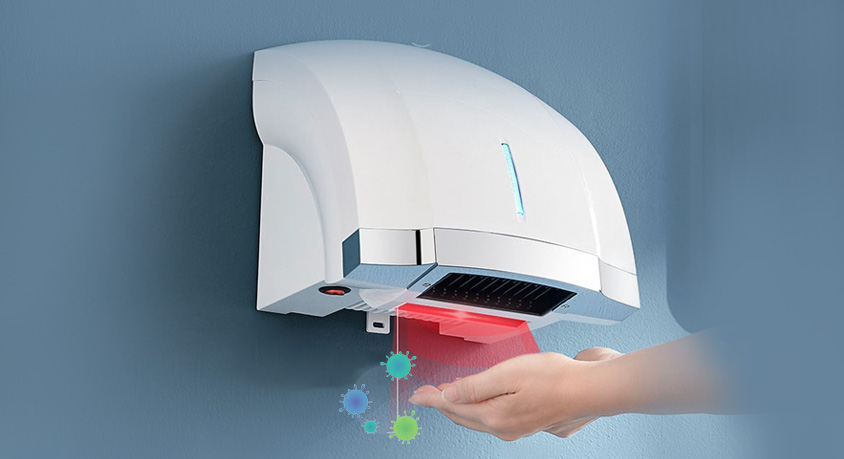
A 1997 study published in Epidemiology showed that warm-air hand dryers require about 45 seconds to reduce residual moisture on hands to 3 percent. In contrast, using a disposable cloth towel reduces moisture to 4 percent in about 10 seconds, and to 1 percent in 15 seconds.
Of course, cloth towels are not common in most restrooms. Fortunately, a 2008 academic report from the European Tissue Symposium addresses this by comparing the drying efficiency of paper towels, warm-air dryers, and jet-air dryers.
The report found that both paper towels and jet-air dryers can reduce moisture to below 10 percent within 10 seconds, while warm-air dryers require more than 50 seconds to achieve similar dryness.
In reality, people do not spend that much time using warm-air dryers. Men use them for an average of 17 seconds, and women for 13.3 seconds—far too short to achieve ideal dryness.
Wet hands more easily pick up bacteria when touching contaminated surfaces (such as door handles).
Therefore, in terms of drying efficiency, paper towels, cloth towels, and jet-air dryers perform well, whereas warm-air dryers perform less effectively.
Next is the impact of hand dryers on the number of bacteria on the hands.
First, it must be stated that findings on the bacterial reduction efficacy of paper towels versus hand dryers vary widely between studies.
A 2020 review published in Applied and Environmental Microbiology summarized 23 related studies and identified whether their funding sources were private (industry) or public.
Depending on the funding source, the conclusions differ significantly.
For example, the European Tissue Symposium report concluded that paper towels are the best method, with both warm-air and jet-air dryers increasing bacterial residues on the hands.
In contrast, research funded by a jet-air dryer manufacturer found the opposite—claiming that jet-air dryers reduced bacterial colony counts more effectively than paper towels.
Here, we focus on studies supported by public funding. However, even publicly funded research arrives at different conclusions.
For instance, a 1991 study found that warm-air dryers performed better than paper towels. But that study was conducted in a microbiology lab restroom, which has much better hygiene than typical public restrooms. Moreover, the dryers were preheated for one minute before use to ensure optimal performance.
This differs greatly from real-world usage. For a more realistic representation, the following study is more relevant.
In 2018, a study published in the Journal of Infection Prevention examined dryers installed in university campus restrooms.
These restrooms had high foot traffic and hygiene conditions inferior to those in laboratory facilities. In the study, dryers were used normally without any special disinfection.
The study found that when using paper towels, bacterial colony counts decreased on both fingertips and palms. With jet-air dryers, fingertip bacterial counts increased, while palm counts decreased slightly—but not significantly. When warm-air dryers were used, bacterial colony counts increased on both fingertips and palms. This is truly a case of “using it makes things worse.”
However, the study also noted that the dryers themselves were not necessarily the source of contamination.
When we use hand dryers, they must draw in surrounding air—and in a restroom, that air may be contaminated. If the dryer lacks proper filtration, it may blow restroom bacteria onto your wet hands.
For example, wall samples beneath warm-air dryers showed higher microbial levels, possibly because moist conditions below the dryer favor bacterial growth. When the dryer is operating, these bacteria may be blown onto hands. More bacteria were also detected around jet-air dryers compared to paper towel dispensers.
Therefore, the study concluded that from a public health perspective, paper towels are superior to hand dryers. For personal use as well, if both are available in a public restroom, paper towels are recommended.
Although paper towels are preferred, this does not mean all hand dryers should be dismissed. As mentioned earlier, if the restroom environment is clean, bacterial levels in the air blown out by dryers are reduced.
Some modern dryers include built-in filters, and high-quality filters can effectively remove airborne particles and bacteria. Regular replacement of these filters can help address hygiene issues.
Additionally, a 2005 study published in Infection Control & Hospital Epidemiology found that warm-air dryers equipped with ultraviolet sterilization also reduced bacterial colony counts.
As public restroom hygiene continues to improve and hand-dryer technology advances, we do not need to reject hand dryers entirely. But if you find yourself in a dirty restroom with only an old, worn-out warm-air dryer, it may be wiser to simply “shake your hands and walk away.”

