

At first glance, Balatro looks like a cheap poker knockoff—cards, bets, a dealer that’s definitely cheating (or so you’ll swear at 2 a.m.). But five minutes in, you’ll realize this isn’t Texas Hold’em with a roguelike coat of paint. It’s a math playground disguised as a card game, where royal flushes are just the starting line and “jokers” aren’t just wild cards—they’re cheat codes that turn your hand into a number-crunching weapon. Poker purists will scoff, math haters will panic, and everyone else will find themselves staying up way too late chasing that one perfect combo that breaks the game. So why has this tiny indie title become the surprise hit of the year? Because Balatro doesn’t care about poker rules—it cares about letting you win big with math, not luck.
In real poker, you’re at the mercy of probability. A straight flush is a 1 in 64,974 shot, and that’s that. In Balatro, probability is just a suggestion. The game’s secret sauce is its Jokers—special cards that multiply your hand’s value, bend the rules of card types, or turn garbage hands into goldmines. One Joker might double your payout for every heart in your hand; another could turn all aces into wild cards and triple their value. Suddenly, a “bad” hand of 2s, 3s, and a joker becomes a payout monster, and you’re not just playing cards—you’re building a mathematical machine. Balatro deconstructs poker into its core parts (ranks, suits, hands) and lets you hack them, turning the game from a test of luck into a puzzle where you hunt for the perfect combination of Jokers, modifiers, and card sets to hit absurdly high scores.
What makes this addictive is how it flips the poker script. In regular poker, you’re praying the river card saves you; in Balatro, you’re the one pulling the strings. You’ll spend rounds drafting Jokers that synergize—pairing a “Double Flush” Joker with one that boosts diamond payouts, then stacking in modifiers that turn every bet into a jackpot. A hand that would get you laughed out of a real casino becomes a 100,000-point beast, and the rush of seeing those numbers skyrocket is better than any royal flush. Even better? When your carefully crafted combo backfires (like accidentally betting too much and busting), it’s funny, not frustrating—you’ll reset and immediately start plotting a better, more broken strategy.
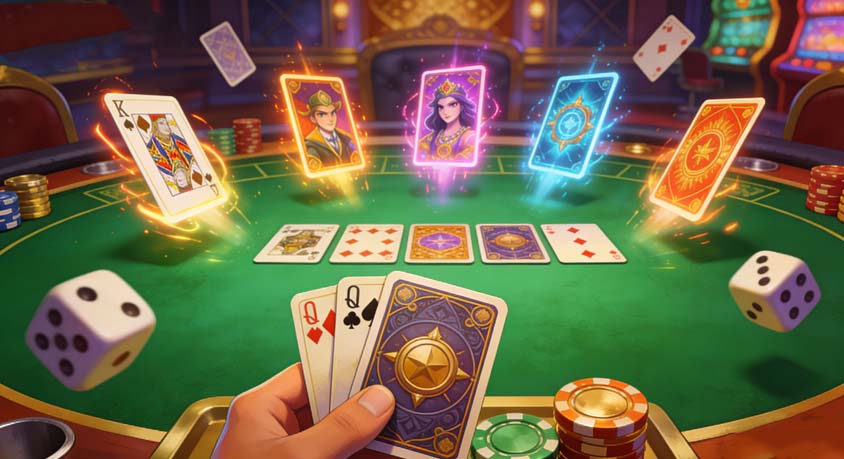
Balatro also nails the roguelike loop that keeps you coming back. Every run is different: new Jokers, new challenges, new ways to break the game. You’ll try a “low card” build one round, a “flush spammer” the next, and a “wild card chaos” run that somehow pays off better than both. The game doesn’t punish failure—it rewards experimentation. Missed a big combo? No problem—next run, you’ll grab that one Joker you missed and turn your luck around. Unlike roguelikes that feel punishing, Balatro feels like a playground where every mistake is a lesson in how to game the system harder next time.
Poker haters will love it because it ditches the stress of bluffing and luck; math nerds will drool over the multiplicative synergies; and casual gamers will get hooked on the simple “draw, play, bet” loop that hides layers of strategy. It’s a game that’s easy to learn (you know what a pair is, right?) but impossible to master—there’s always a new Joker combo to discover, a new way to squeeze more points out of a hand, a new rule to bend until it snaps.
By the time you’re three hours deep, you’ll forget you’re even playing something that looks like poker. You’ll be yelling at your screen as a Joker multiplies your hand’s value by 10, high-fiving yourself when you hit a million-point bet, and wondering how a game about math and cards got this addictive. Balatro isn’t just a poker roguelike—it’s a power fantasy for anyone who’s ever wanted to beat the odds (and the dealer) with nothing but a little creativity and a lot of multiplication.

