

Let’s get one thing out of the way: most games treat you like a toddler with a GPS. “Go here!” “Kill that!” “Follow this glowing arrow!” Then there’s Elden Ring and its Soulslike cousins, which toss you into a vast, terrifying world with zero hand-holding—no map markers, no quest logs, no “you’re going the wrong way” alerts. You’d think this would be a disaster, right? A recipe for frustration and getting lost in a forest of death. But here’s the twist: that lack of UI isn’t a flaw—it’s the secret to why exploration feels like discovering hidden treasure, not checking off a to-do list.
Let’s break the silent guidebook: Elden Ring doesn’t need pop-ups to tell you where to go—it uses the world itself. A distant castle spire piercing the clouds? That’s your next destination. A narrow path lit by faint torchlight, winding through monster-infested ruins? Follow it. Even enemy placement is a clue: a group of weak soldiers patrolling a bridge means something important (or deadly) lies ahead. You’ll find yourself leaning in, squinting at the screen, thinking “What’s over that hill?” instead of staring at a mini-map. It’s exploration like we used to know it—before games decided we couldn’t handle a little confusion. Remember the joy of stumbling on a hidden cave in Zelda, or a secret level in Mario? Elden Ring cranks that up to 11, turning every wrong turn into a potential adventure. You might wander for 45 minutes, get killed by a giant wolf, and still grin when you spot a glowing summon sign or a chest full of loot tucked behind a waterfall.
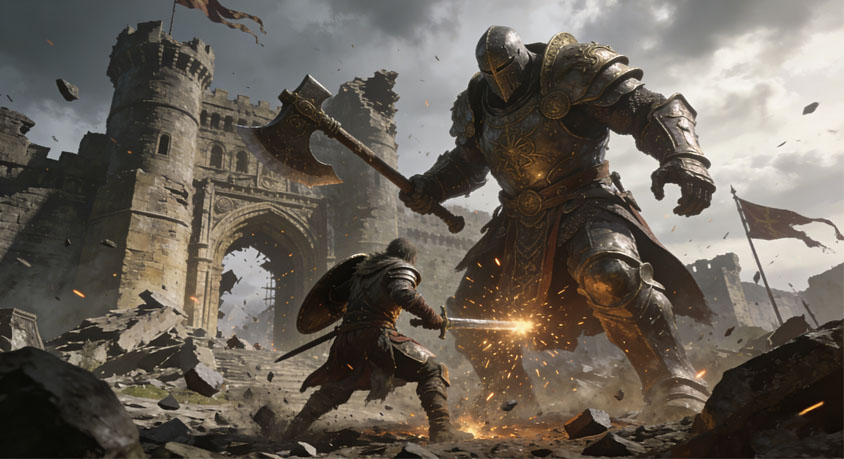
Now, let’s talk about the “hard” part—combat. Soulslikes have a reputation for being brutal, but Elden Ring flipped the script with Ashes of War and Spirit Ashes, and it’s genius. This isn’t “easy mode”—it’s “choice mode.” New players can summon a spectral wolf or a band of warriors to distract bosses, turning a one-sided beatdown into a team fight. Veterans can swap out weapon skills, slapping a gravity-crushing slam on a sword or a rapid-fire stab on a dagger, turning combat into a creative dance of destruction. The core “learn-die-learn” loop is still there—you’ll still spend 20 minutes memorizing a boss’s attack patterns—but now you can tailor your strategy to your skill level. Want to brute-force it with a giant hammer? Go for it. Want to cheese it by summoning allies and spamming magic? No judgment. The game doesn’t punish you for playing “wrong”—it rewards you for finding what works. It’s difficulty with heart, not cruelty.
What makes this all click is the respect it has for players. Unlike games that hold your hand through every step, Elden Ring trusts you to figure it out. It says “We made a beautiful, dangerous world—go explore it, mess up, and discover things on your own.” That trust turns frustration into pride: when you finally reach that castle spire after hours of wandering, or beat that boss without summoning a single ally, it feels earned. You didn’t follow a guide—you forged your own path. And the best part? You’ll remember those moments forever. Not the time you checked a quest log, but the time you got lost in a swamp, fought a crocodile, and stumbled on a legendary weapon that changed your playstyle.

